EDUCATION
Welcome to the Feagin Leadership Program Education Hub
This section offers valuable tools designed to support and enhance your leadership journey. Whether you're a Feagin alum seeking a refresher from past sessions or someone eager to develop your skills as a healthcare leader, the resources here may be exactly what you need. Explore the Duke Healthcare Leadership Model and dive into each corresponding section to access resources tailored to each element of this model.
Feagin Leadership Program – PCLT
EDUCATION
The Duke Healthcare Leadership Model
he Healthcare Leadership Model (HLM) was developed by a group of medical students, residents and fellows promote the importance of a competency-based leadership model for healthcare education.. The model was created between 2014 [1] and 2017 through an extensive literature review, focus groups of faculty and trainees, and a mixture of qualitative and quantitative analysis. The attained goal was to synthesize the core skills/competencies necessary trainees to be better leaders – primarily in a healthcare setting.
The definition of leadership the group used in order to focus the research was “the ability to influence others for the benefit of patients and patient populations”. Since publication, this definition and the model have been used as a framework to enhance education and patient care throughout educational medical communities. The model recognizes that there is a need for medical trainees at all stages to receive education that equips them with the skills and tools necessary to address professional leadership challenges. The model is based on the core principle of Patient Centeredness and competencies of Emotional Intelligence, Critical Thinking, Integrity, Service and Teamwork.
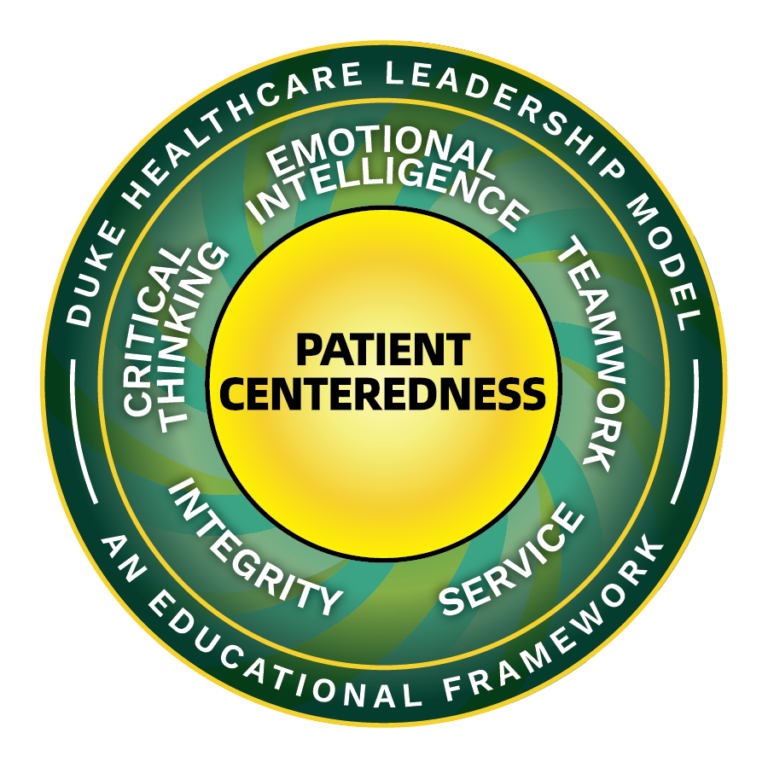
Core Principle - Patient Centeredness
Acting with focus on the values and goals of patients.
Core Competencies - Critical Thinking
Using all available sources of knowledge to create appropriate and effective solutions while being aware of internal and external biases.
Core Competencies - Service
Prioritizing other’s needs over individual wants and desires, while maintaining personal and professional balance.
Core Competencies - Teamwork
Collaborating and maximizing one’s role to enhance team performance and cohesion.
Core Competencies - Integrity
Being honest and acting in accordance with strong moral principals in one’s personal and professional life.
Core Competencies - Emotional Intelligence
The ability to recognize and understand thinking and emotions in yourself and others; and to use this awareness to effectively manage your behavior and relationships.
- Epstein, R. (1999). Mindful practice, JAMA, 282 (9): 833-839.
- Eichbaum, Q. (2014). Thinking about thinking and emotion: the metacognitive approach to the medical humanities that integrates the humanities with the basic and clinical sciences. The Permanente Journal, 18, 4: 64-75.
- Cohen-Katz, J., Sternlieb, J., Hansen, S., & Dostal, J. (2016). Developing emotional intelligence in a clinical learning environment – a case study in cultural transformation. Journal of Graduate Medical Education, 1: 692-698.
- Hargett, C., Doty, J., Hauck, J., Webb, A., Cook., S., Tsipis, N., Neumann, J., Andolsek, K., & Taylor, D.(2017). Developing a model for effective healthcare leadership: a concept mapping approach. Journal of Healthcare Leadership, 9: 69-78.
- Souba, C. (2010). The language of leadership. Academic Medicine, 85 (10): 1609-1617.
- Crites, G., Ebert, J., & Schuster, J. (2008). Beyond the Dual Degree: Development of a Five-Year Program in Leadership for Medical Undergraduates. Academic Medicine, 83:52–58.
- Waldhausen, J. (2001, March). John H Gibbons Leadership Series – Leadership in medicine. Bulletin of the American College of Surgeons.
- Anderson, K., Cobb, M., Gunasingha, R., Waldron, N., Atia, A., Bailey, J., Doty, J.,Boswick-Caffrey, J., Taylor, D. (2017). Improving medical leadership education through the Feagin program. International Journal of Medical Education, 8: 290-291.
- Webb, A., Tsipis, N., McClellan, T., McNeil, M., Xu, M., Doty, J., Taylor, D. (2014). Leadership curricula in undergraduate education: A systematic review. Academic Medicine, 89(11): 1563-1570.
- Murphy, K., McManigle, J., Wildman-Tobriner, B., Jones, A., Dekker, T., Little, B., Doty, J., Taylor, D. (2016, Oct). Design, Implementation, & Demographic Differences of HEAL: a Self-Report Healthcare Leadership Instrument. Journal of Healthcare Leadership.
- Remember the Titans
- Patch Adams
- A Few Good Men (integrity)
- Sleepers (integrity, EI, teamwork, service, critical thinking)
- The Shawshank Redemption
- Saving Private Ryan – (D-Day/WWII) – leadership in extreme context, psychological challenges
- Born on the 4th of July (Vietnam, the struggles of a wounded veteran) – loyalty/values, resilience
- Schindler’s List (WWII, Holocaust) – values, psychological challenges, resilience